
Introduction
When developer Mega Crit released Slay the Spire, few predicted that a small indie title blending card games with procedural dungeon crawling would ignite a massive revival in tabletop-inspired digital game design. Years after its official launch, Slay the Spire remains the undisputed gold standard of roguelike deckbuilders.
At its core, the game takes two distinct genres—turn-based tactical card strategy and permadeath roguelikes—and fuses them into a tightly balanced experience where every single card draft, path choice, and energy spend carries long-term consequences.
This comprehensive analysis breaks down the fundamental mechanics, character synergies, advanced routing strategies, and high-level deckbuilding principles that make Slay the Spire a modern masterpiece of game design.
Anatomy of the Spire: Core Gameplay Mechanics
The objective of Slay the Spire is straightforward: select one of four distinct heroes and navigate through three procedurally generated acts (plus a secret final fourth act) to reach and destroy the Heart of the Spire. However, executing this goal requires deep tactical planning and resource management.
The Map and Pathing Dynamics
Every run presents players with a branching tree map populated by various node types:
- Monster Encounters (Hallway Fights): Standard battles that reward gold, potions, and a choice of one out of three random cards to add to your deck.
- Elite Encounters: Highly dangerous mini-boss battles that grant significant gold, card rewards, and invaluable passive items known as Relics.
- Rest Sites (Campfires): Safe nodes where players must choose between restoring 30% of their maximum HP or permanently upgrading a single card in their deck.
- Shops: Establishments where players spend accumulated gold to buy specific cards, acquire powerful relics, stock up on combat potions, or pay to remove unwanted cards from their deck.
- Unknown Rooms (? Events): Dynamic text-based encounters offering high-risk, high-reward choices, such as trading maximum HP for gold or altering specific cards.
Effective path planning requires balancing risk against growth. Taking too few Elite fights leaves your character underpowered for the Act Boss, while taking too many back-to-back Elites without a Rest Site can end a run prematurely.
Combat and the Intent System
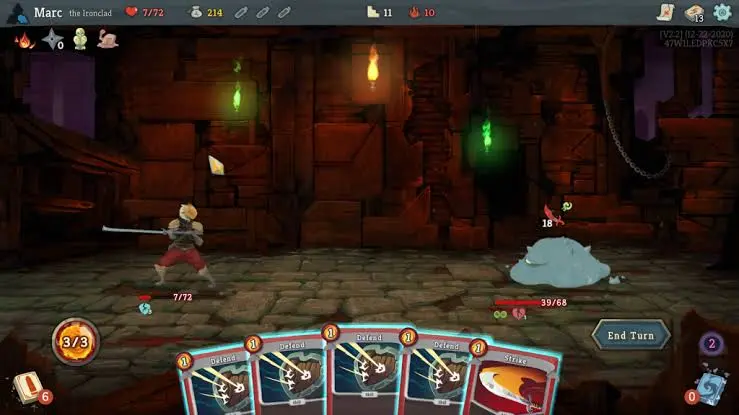
Combat operates on an energy-based turn system. Players typically start each turn with 3 base energy and draw 5 cards from their deck. Unplayed cards are sent to the discard pile at the end of the turn rather than kept in hand, forcing players to play reactively to the current draw.
The defining feature of Slay the Spire’s combat is the Intent System. Enemies clearly display their upcoming actions—such as attacking for specific damage, blocking, applying status debuffs, or charging up massive moves. This turns combat into a transparent strategy puzzle. Victory is not dependent on guessing enemy moves, but rather on calculating the most efficient way to mitigate damage while advancing your win condition.
Strategic Breakdown: The Four Playable Classes
Each hero in Slay the Spire features completely distinct card pools, starting relics, and core mechanics. Mastering the game requires understanding how each class scales damage and defense.
| Character | Class Identity | Key Strengths | Core Deck Archetypes |
| The Ironclad | Brute force warrior utilizing sacrifice and raw strength | High baseline survivability via innate self-healing after battle | • Strength Stacking (Demon Form, Limit Break) • Exhaust Engine (Corruption, Dark Embrace) • Block-to-Damage Conversion (Body Slam) |
| The Silent | Swift assassin utilizing toxins, speed, and card velocity | Superior card draw capacity and defensive turn setup | • Poison Scaling (Catalyst, Deadly Poison) • Shiv Spam (Blade Dance, Accuracy) • Discard Engine (Tactician, Reflex) |
| The Defect | Automated elemental construct using Orb slots | Unmatched passive resource generation and Focus scaling | • Frost Turtling (Glacier, Blizzard) • Lightning Burst (Electrodynamics, Thunderstrike) • Plasma Energy Loops & Focus Stacking (Defragment) |
| The Watcher | Disciplined monk leveraging volatile stance changes | Devastating damage spikes capable of single-turn kills | • Stance Dancing (Wrath/Calm, Rushdown) • Divinity Burst (Mantra Stacking) • Scry Control (Weave, Third Eye) |
Advanced Strategy: Deck Consistency and Relic Economies
The most common trap for new players is treating Slay the Spire like a collection game, taking a card reward after every single fight. High-level play revolves around deck manipulation and consistency.
The Importance of Card Removal
Starter decks contain basic “Strike” and “Defend” cards, which are mathematically inefficient compared to reward cards. A bloated deck of 35 cards dilutes your probability of drawing your most powerful win conditions.
By prioritizing card removal at Shops and Event nodes, players keep their decks lean. A streamlined deck of 15 to 20 highly synergistic cards allows core combos to be drawn every 2 to 3 turns, ensuring dependable defense and offensive output.
Short-Term Survival vs. Long-Term Scaling
Winning runs requires solving immediate problems rather than forcing pre-planned builds:
- Act 1 Focus: Acquire high immediate damage cards (e.g., Carnage or Predator) to survive aggressive Elite fights like the Gremlin Nob.
- Act 2 Focus: Build area-of-effect (AoE) damage and robust defensive engines to survive multi-enemy encounters and heavy debuffs.
- Act 3 & 4 Focus: Secure exponential scaling mechanics (e.g., Strength, Poison, or Focus) to outpace massive boss health pools.
The Relic Dynamic
Relics are permanent passive items that alter fundamental game rules. Acquiring a Boss Relic like Snecko Eye (which randomizes card costs but draws two extra cards every turn) or Runic Pyramid (which prevents you from discarding your hand) can completely alter your strategic direction midway through a run, rewarding players who adapt on the fly.
The Ascension System: Ultimate Replayability
After winning a run with a character, players unlock Ascension 1. The Ascension system consists of 20 stacking difficulty levels designed to challenge seasoned players.
- Ascension 1–5: Introduces elite density, higher shop prices, and deadlier standard enemies.
- Ascension 6–15: Reduces health regeneration, degrades starting stats, and adds parasitic curses to starting decks.
- Ascension 17–20: Enforces ruthless enemy attack patterns, reduces potion slots, and requires players to fight two back-to-back Act 3 Bosses before advancing to the final act.
At Ascension 20, Slay the Spire becomes a unforgiving test of probability management, micro-calculations, and resource efficiency.
Pros & Cons
Pros
- Masterful Game Design: Exceptional balance ensures every character has multiple viable paths to victory even at the highest difficulty tiers.
- High Replayability: Procedurally generated maps, randomized card drafts, hundreds of unique relics, and 20 Ascension tiers provide endless gameplay variations.
- Deterministic Information: The Intent System removes cheap surprises, ensuring that deaths are almost always the result of player error or poor planning rather than pure bad luck.
- Zero Pay-to-Win Mechanics: A complete package with no microtransactions, battle passes, or paywalled content.
Cons
- Minimalist Visuals: The visual style and 2D character animations are simple, which may not appeal to players seeking high-end graphic fidelity.
- Steep Initial Learning Curve: Punishing difficulty spikes in Acts 2 and 3 can feel unforgiving to newcomers unfamiliar with deckbuilding mechanics.
- Run Length: Deep, calculated runs on high Ascension levels can take between 60 to 90 minutes, requiring sustained mental effort.
Frequently Asked Questions (FAQs)
Q: Is Slay the Spire difficult for beginners?
A: While the basic rules of spending energy to play cards are simple to learn, the game has a steep learning curve. Mastering enemy patterns, card synergies, and pathing choices takes time, but early difficulty levels remain welcoming to new players.
Q: Should I pick a new card after every battle?
A: No. Skipping card rewards is a vital mechanic. Adding subpar cards dilutes your deck and lowers the chances of drawing your strongest cards when you need them most.
Q: How do I unlock the Secret Act 4 (The Heart)?
A: After beating the game with the first three characters (Ironclad, Silent, and Defect), three colored Keys will appear in subsequent runs. You must collect the Ruby Key (at a Rest Site), the Emerald Key (by defeating a buffed Elite encounter), and the Sapphire Key (inside a Non-Boss Chest instead of taking a relic) before beating the Act 3 Boss.
Q: What is the single best strategy to win consistently?
A: Adaptability. Avoid forcing a specific archetype (like a “Pure Poison” deck) early in Act 1. Instead, pick cards that solve your immediate threats, build around the relics you receive, and keep your deck lean through card removals.
Q: Is Slay The Spire available on Android and IOS?
Yes, Slay The Spire is available on both Android and iOS.
Q: Is Slay The Spire free to download on Android and iOS?
Yes, Slay The Spire is free to download on Android and both Android and iOS. You can download download Slay The Spire Exclusively on Betjee.com.pk.
Conclusion
Ultimately, Slay the Spire remains the quintessential entry point and gold standard for anyone exploring the roguelike deckbuilding genre. By seamlessly fusing tactical card play, procedural map navigation, and transparent enemy intentions, it delivers an endlessly replayable strategy experience that rewards adaptability over blind luck. Whether you are battling through early Ascension tiers on PC or optimizing card synergies on mobile, mastering its four distinct heroes and delicate deck-building economy offers hundreds of hours of satisfying gameplay. For fans of deep tactical strategy and dynamic puzzle-solving, ascending the Spire is an essential adventure that continues to set the benchmark for modern indie game design.